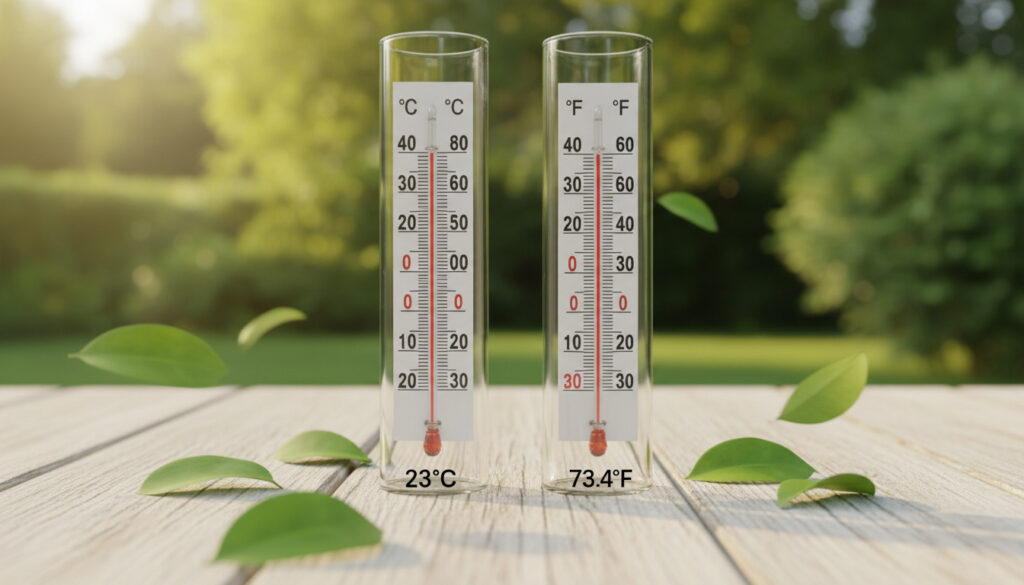
23 Degrees Celsius to Fahrenheit – Exact 73.4°F Conversion Guide
Twenty-three degrees Celsius converts to exactly 73.4 degrees Fahrenheit, a measurement representing ideal room temperature in residential and commercial settings. This value sits precisely in the middle of the standard comfort zone, frequently encountered in climate control systems and meteorological reports across metric-using regions.
The conversion relies on a linear mathematical relationship established through international standards, yielding consistent results whether calculated manually or verified through digital tools. Understanding this specific temperature helps travelers, laboratory technicians, and homeowners maintain comfortable environments across different measurement systems.
What is 23 Degrees Celsius in Fahrenheit?
- 23°C equals exactly 73.4°F using the standard conversion formula
- Serves as a common baseline for comfortable indoor temperature settings
- Frequently used in European contexts as standard room temperature
- Falls precisely in the middle of the 20-25°C comfort zone
- Reverse conversion (23°F) yields -5°C, a significant difference
- Mathematical precision requires calculation to one decimal place
| Celsius (°C) | Fahrenheit (°F) | Context |
|---|---|---|
| 20 | 68.0 | Cool room temperature |
| 21 | 69.8 | Comfortable indoor setting |
| 22 | 71.6 | Pleasant ambient temperature |
| 23 | 73.4 | Ideal room temperature |
| 24 | 75.2 | Warm room conditions |
| 25 | 77.0 | Upper comfort range |
Inch Calculator verifies that 23°C equals exactly 73.4°F using the standard thermal conversion formula.
How to Convert Celsius to Fahrenheit
The mathematical relationship between Celsius and Fahrenheit relies on a linear transformation accounting for the different zero points and scale intervals of each system. Cuemath provides the authoritative formula used for this conversion.
The Conversion Formula
The precise equation states: °F = (°C × 9/5) + 32. This formula accounts for the 32-degree offset between the two scales’ freezing points and the 9/5 ratio reflecting the different magnitudes of each degree unit.
Step-by-Step Calculation for 23°C
- Multiply 23 by 9, resulting in 207
- Divide 207 by 5, yielding 41.4
- Add 32 to 41.4, producing exactly 73.4°F
For quick approximations without a calculator, multiply the Celsius value by 2 and add 30. For 23°C, this yields 76°F—close to the exact 73.4°F. Brighterly notes this method typically provides results within 1-2 degrees of precision.
Common Temperatures Near 23°C in Fahrenheit
Temperatures surrounding 23°C appear frequently in climate control and weather forecasting contexts. Newark’s conversion resources confirm these adjacent values.
20°C and 25°C Conversions
Twenty degrees Celsius equals 68°F, often cited as the lower bound of comfortable room temperature. Twenty-five degrees Celsius converts to 77°F, representing the warmer end of the indoor comfort spectrum.
Room Temperature Standards
The range between 20-25°C (68-77°F) defines standard room temperature across most residential and commercial HVAC guidelines. This span accommodates individual preferences while maintaining energy efficiency and physiological comfort.
Is 23 Degrees Celsius Hot, Cold, or Comfortable?
Twenty-three degrees Celsius generally registers as comfortable rather than extreme. Mathematical references confirm this falls within temperate ranges.
Comfort Zone Analysis
This temperature sits precisely in the middle of the widely accepted comfort zone of 20-25°C. Most individuals experience 23°C as neither chilling nor overheating, requiring neither heating nor cooling in moderate humidity conditions.
Twenty-three degrees Fahrenheit equals -5°C, a significantly colder temperature below freezing. Always verify which scale applies when interpreting thermostat settings or weather reports to avoid dangerous misunderstandings.
While 23°C translates mathematically to 73.4°F, perceived comfort varies with humidity levels and air movement. High humidity can make this temperature feel warmer, while drafty conditions may render it cool.
Historical Development of Temperature Scales
- : Daniel Gabriel Fahrenheit establishes the Fahrenheit scale using a mixture of ice, water, and salt for zero, and human body temperature for 96°.
- : Anders Celsius proposes the centigrade scale, initially reversed (0° boiling, 100° freezing) before adoption of the modern orientation.
- : The Celsius scale receives official nomenclature standardization from the General Conference on Weights and Measures.
- : Celsius becomes the global scientific standard, while Fahrenheit persists in the United States and some Caribbean nations for non-scientific applications.
Precision and Accuracy in Conversion
| Verified Information | Subjective Variables |
|---|---|
| 23°C = 73.4°F (mathematically exact) | Individual thermal comfort preferences |
| Formula standardized since 1742 | Humidity effects on perceived temperature |
| 20-25°C defined as room temperature range | Clothing and activity level variations |
| Conversion precise to one decimal place | Seasonal acclimatization differences |
Practical Applications of 23°C
Laboratories, pharmaceutical storage facilities, and residential thermostats frequently target 23°C as an equilibrium point. This temperature supports stable chemical reactions while maintaining human comfort during sedentary activities.
International weather services report daily highs near 23°C during temperate seasons, correlating with spring and autumn conditions in moderate climates. These readings influence agricultural planning, energy consumption forecasts, and public health advisories regarding heat stress or cold exposure. Those tracking major international sports events might note that Programmation de Coupe d’Afrique des Nations de Football 2025 – Dates, Groups and Full Schedule typically involves stadium climate control maintaining similar thermal parameters for athlete performance.
Standards and Verification
The Celsius and Fahrenheit scales relate through the linear equation °F = 1.8°C + 32, derived from the defined freezing and boiling points of water under standard atmospheric conditions.
NIST (National Institute of Standards and Technology) thermal measurement standards
Temperature conversions require precision to 0.1 degrees for scientific applications, though household thermostats typically maintain accuracy within ±1 degree.
International Bureau of Weights and Measures (BIPM) guidelines
Quick Reference Summary
Twenty-three degrees Celsius converts to exactly 73.4 degrees Fahrenheit using the formula °F = (°C × 9/5) + 32. This temperature represents comfortable room conditions, distinct from the freezing conditions of 23°F (-5°C). For additional technical specifications regarding device thermal operating ranges, see Apple AirPods Pro 3 – Release Date, Price and Key Features.
Frequently Asked Questions
What is 23 degrees Fahrenheit in Celsius?
Twenty-three degrees Fahrenheit equals -5°C, calculated using °C = (°F – 32) × 5/9. This represents freezing conditions, significantly colder than 23°C.
What is the room temperature in Celsius and Fahrenheit?
Standard room temperature ranges from 20-25°C (68-77°F), with 23°C (73.4°F) representing the midpoint of this comfort zone.
Is 23 degrees Celsius hot or cold?
Twenty-three degrees Celsius is considered comfortable and mild, neither hot nor cold. It corresponds to pleasant spring weather and ideal indoor conditions.
How do you convert Celsius to Fahrenheit quickly?
Multiply the Celsius value by 2 and add 30 for a rough estimate. For 23°C, this yields approximately 76°F, within 3 degrees of the exact 73.4°F.
What is 23 degrees Celsius in Fahrenheit exact?
The exact conversion is 73.4°F, calculated as (23 × 9/5) + 32 = 41.4 + 32.
Why is 23°C considered room temperature?
Twenty-three degrees Celsius falls in the center of the 20-25°C comfort range, providing thermal neutrality for most people wearing light clothing in still air.
What does 23°C feel like?
Twenty-three degrees Celsius feels like a mild spring or autumn day—warm enough for light clothing but cool enough to remain comfortable during physical activity.
More related posts
 Mélanie Joly: Biography, Career, Net Worth, Contact
 Brandi Carlile: Biography, Health, LGBTQ Identity, and Family
 Larry David: Net Worth, Seinfeld Friendship, Real Personality
 Zachery Ty Bryan: Home Improvement Star’s Prison Sentence
 Downs and Son Funeral Home Obituaries in Hepworth, ON
 Salon Funéraire Bérubé et Fils Alma – Funeral Services Guide
 Carolyn Bessette: Life, Death, and Legacy of JFK Jr.’s Wife
 Mookie Betts: Illness, Return & Retirement Plans
