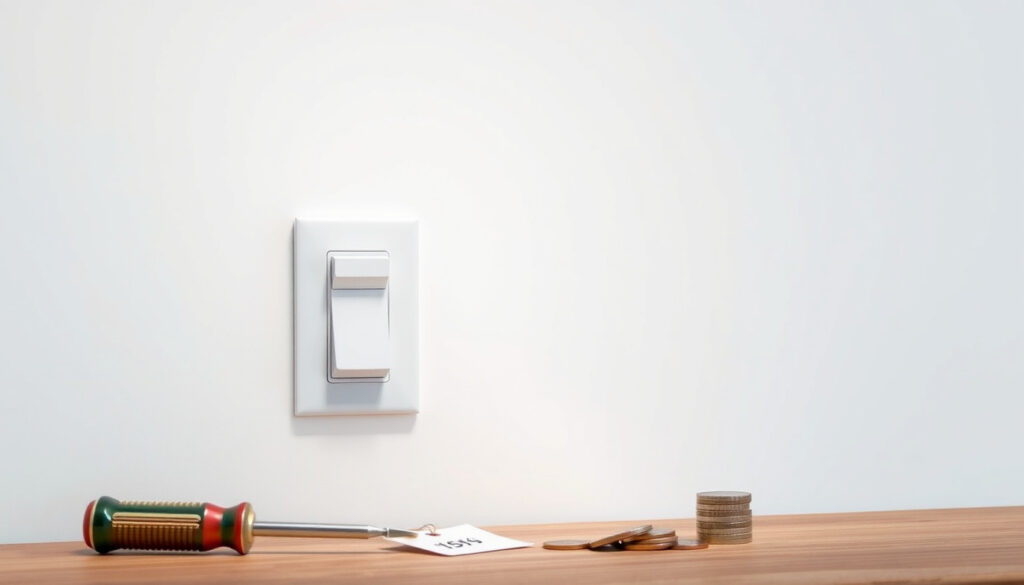
Light Switches: Types, Costs & DIY Replacement
Anyone who’s faced a flickering switch or wanted to brighten a dim room knows the question: call an electrician or learn to do it yourself? In Ireland, the answer involves wiring type, local regulations, and real costs — with professional replacement averaging €80–€150 per switch, according to Stillorgan Electrical Services, knowing your options saves both money and hassle.
Basic light switch types: 4 (single-pole, three-way, four-way, dimmer) ·
Average professional replacement cost (Ireland): €80–€150 ·
DIY replacement time: 15–30 minutes ·
Standard voltage in Ireland: 230V AC
Quick snapshot
- Turning off power at the breaker is essential before any switch work (Stillorgan Electrical Services)
- Dublin electricians typically charge €100–€150 in labour for a dimmer switch replacement (Stillorgan Electrical Services)
- Four common types: single-pole, three-way, four-way, and dimmer switches (Wikipedia (general reference))
- Whether a dimmer switch requires a neutral wire depends on the specific model and whether it is a smart dimmer (MyBuilder (UK trades marketplace))
- Evening or weekend work may attract an emergency electrician fee in Dublin, though exact surcharges vary (Stillorgan Electrical Services)
- DIY replacement takes 15–30 minutes; professional call-outs are typically scheduled within 1–3 days (MyBuilder)
- A standard dimmer switch costs €20–€40 before labour; smart dimmers range €50–€100 (Stillorgan Electrical Services)
- Assess your current switch type and decide between DIY or professional replacement (Screwfix Ireland (electrical retailer))
- For complex wiring (three-way or four-way setups), hiring an electrician is recommended (MyBuilder)
Four switch categories, one clear pattern: the simpler the circuit, the cheaper and faster the replacement.
| Switch type | Typical switch cost (Ireland) | Professional labour cost (Ireland) | DIY difficulty |
|---|---|---|---|
| Single-pole (basic on/off) | €5–€15 | €80–€150 | Easy – direct replacement |
| Three-way (two locations) | €10–€25 | €100–€200 | Moderate – requires correct traveler wiring |
| Four-way (three+ locations) | €15–€30 | €120–€250 | Hard – complex circuit configuration |
| Dimmer switch | €20–€40 (standard); €50–€100 (smart) | €100–€250 | Moderate – check neutral and LED compatibility |
The trade-off: a basic single-pole replacement is the cheapest and simplest DIY job, while dimmer and multi-location switches involve wiring decisions that often justify a professional’s fee.
Do I Need an Electrician to Replace a Light Switch?
When to hire an electrician
- If your home has older wiring (pre-2000s) that may not match modern colour codes, an electrician ensures compliance with Irish standards (Stillorgan Electrical Services).
- Three-way or four-way circuits — where a switch is wired to control lights from multiple locations — are significantly more complex and best left to a pro (MyBuilder).
- Any job that involves moving the switch location or adding new wiring requires a registered electrician under Irish building regulations.
Cost of professional replacement
- A qualified electrician in Dublin typically charges €100–€150 in labour for a dimmer switch replacement (Stillorgan Electrical Services).
- Total cost for a standard dimmer switch replacement in Dublin: €100 to €250 or more per switch, including materials (Stillorgan Electrical Services).
- For comparison, UK electricians charge around £40 to £70 per hour (MyBuilder).
- In the US, the national average cost to replace an electric switch starts at $126 to $314 per switch (Homewyse (US cost estimator)).
Risks of DIY wiring
- The biggest risk is live-circuit contact. Always turn off the circuit breaker and test wires with a voltage tester before touching anything.
- Reversing live and load wires can create a short circuit or leave the switch non-functional. Identifying common (COM), live (L), and load wires correctly is critical.
- Non-compliance with Irish wiring rules (IS 10101) could invalidate your home insurance.
For a simple single-pole swap, a confident DIYer with the right tools can save €80–€150. For any circuit involving three or more switches, or if you are unsure about wiring, the cost of hiring an electrician is cheap insurance against a costly mistake.
What Are the Four Types of Light Switches?
Single-pole switches
- The most common type: controls one light or fixture from a single location.
- Has two brass-coloured screw terminals (for live and load wires) plus a green ground screw.
- Easiest to replace DIY — just two active wires and a ground.
Three-way switches
- Controls a single light from two separate locations, such as the top and bottom of a staircase.
- Has three terminals (common plus two travellers) plus ground. Colour coding matters: the common screw is usually darker.
- Requires matching the correct wire to the correct terminal — a common DIY error point.
Four-way switches
- Used in combination with two three-way switches to control a light from three or more locations.
- Has four terminals (two pairs of travellers) and sits in the middle of the circuit.
- Complex to wire correctly; professional installation is strongly advised.
Dimmer switches
- Allows adjustable brightness levels for compatible bulbs.
- Standard dimmers cost €20–€40 before labour in Dublin; smart dimmers range €50–€100 (Stillorgan Electrical Services).
- LED-compatible dimmer switches cost more than standard dimmers (Stillorgan Electrical Services).
- Not all dimmers work with all bulbs — check compatibility with LED or CFL bulbs before buying.
The pattern: the more locations you want to control a light from, the more complex the switch and the higher the installation cost. A single-pole switch is the entry-level workhorse; four-way setups are specialist territory.
Can I Replace a Dimmer Switch with a Regular Switch?
Steps to replace a dimmer with a standard switch
- Turn off power at the circuit breaker. Confirm with a voltage tester.
- Remove the dimmer faceplate and unscrew the dimmer unit from the wall box.
- Disconnect the wires (typically black to live, red or black to load, and a green or bare ground).
- Connect the new standard switch: black wire to brass screw, white (if present) to silver screw, ground to green screw.
- Mount the switch, attach the faceplate, restore power, and test.
Wiring differences
- Standard on/off switches are simpler — they have two active terminals (live and load) and a ground.
- Dimmers may have an extra wire for the dimmer mechanism. In many modern dimmers, a neutral wire is required. If your dimmer has a neutral, the standard switch may not need it.
- If the dimmer is a smart dimmer, check whether the replacement switch will work with the same wiring configuration.
Safety precautions
- Always verify power is off using a non-contact voltage tester before touching any wires.
- Use wire connectors (Wago or screw-style) to secure connections — never leave bare wire exposed.
- If you are unsure about any wire’s function, stop and call an electrician.
Replacing a dimmer with a standard switch is straightforward if the wiring matches — but if the dimmer required a neutral wire, the standard switch will work fine without it. The real risk is misidentifying live and load wires, which can create a short. Test every wire before connecting.
The implication: as long as you understand the wiring, the swap is safe; if the dimmer’s neutral wire is present, the standard switch simply leaves it unused.
Is Switching Off at the Wall the Same as Unplugging?
How wall switches work
- A wall switch controls the flow of electricity to a device by physically opening or closing the circuit.
- When the switch is off, the circuit is broken — no current flows to the device. However, some devices may still draw standby power if the switch is on the neutral side rather than the live side.
When unplugging is necessary
- For appliances with a transformer (phone chargers, laptop power bricks), switching off at the wall may not cut power to the transformer itself, which can still draw a small standby current.
- Unplugging physically disconnects the device from the mains, eliminating all power draw.
- For high-draw devices (space heaters, washing machines), unplugging provides a clear safety benefit when not in use.
Standby power consumption
- Standby power, also called vampire power, accounts for roughly 5–10% of residential electricity use in many countries.
- Switching off at the wall reduces standby draw for devices that have a physical switch on the live side. For others, unplugging is the only way to eliminate it.
- Using a switched socket strip lets you cut power to multiple devices at once — a middle ground between switching and unplugging.
What this means: for energy savings, unplug devices with external power supplies. For convenience, wall switching handles most household items. The distinction matters most for devices that stay on standby 24/7.
How Do I Wire a Light Switch?
Tools needed
- Flathead and Phillips screwdrivers
- Non-contact voltage tester
- Wire strippers
- Wire connectors (Wago or screw-type)
- Replacement switch (correct type for your circuit)
Step-by-step wiring guide
- Turn off the circuit breaker for the switch you are replacing. Confirm power is off with a voltage tester.
- Remove the faceplate and unscrew the old switch from the wall box. Pull it out gently.
- Photograph or label the existing wire connections — this is your reference.
- Disconnect wires from the old switch. Identify common (COM), live (L), and load wires using your photo.
- Connect the new switch: black (live) wire to the brass screw, white (neutral) wire to silver screw if present, ground to green screw.
- Gently push wires into the wall box, screw the switch into place, and attach the faceplate.
- Restore power at the breaker and test the switch.
Common wiring mistakes
- Reversing live and load wires causes the switch to not work or creates a short circuit.
- Leaving exposed wire outside the connector can cause arcing.
- Forgetting to connect the ground wire leaves the switch ungrounded — a safety hazard.
- Overtightening screws can break wire strands or crack the switch body.
A single wiring mistake on a light switch can cost you more than the electrician would have charged — either in a fried device or a call-out fee for emergency repair. If the wires in your wall box don’t match the colours in the guide, do not guess; call a pro.
The takeaway: careful planning and testing minimise risk; when in doubt, the electrician’s fee is cheaper than repairing an accident.
Clarity Check
Confirmed facts
- Turning off power at the breaker is essential before any switch work (Stillorgan Electrical Services).
- Dublin electricians charge €100–€150 in labour for dimmer switch replacement (Stillorgan Electrical Services).
- Single-pole controls one light from one location.
What’s unclear
- Four main types of switches exist: single-pole, three-way, four-way, dimmer (Wikipedia (general reference)).
- Whether a dimmer needs a neutral wire depends on the specific model and smart features (MyBuilder (UK trades marketplace)).
- Evening or weekend electrician surcharges in Dublin vary by contractor and are not standardised (Stillorgan Electrical Services).
- Standby power draw after switching off at the wall differs by device type and wiring configuration.
- UK light switch replacement ranges from £50 to £150 (MyBuilder).
“A straightforward light switch replacement is typically a very quick and simple job. However, the type of switch, the age of the property, and the complexity of the wiring all affect the time and cost involved.”
— MyBuilder (UK trades marketplace)
“In Dublin, replacing a dimmer switch is commonly quoted at €100 to €250 or more per switch, including materials and labour. LED-compatible and smart dimmers cost more than standard models.”
— Stillorgan Electrical Services (Dublin electrical contractor)
Related reading: Replace Light Switch Cost
Before attempting a DIY swap, it’s worth reviewing the local wiring regulations for light switches in Ireland to ensure safety and compliance.
Frequently asked questions
What tools do I need to replace a light switch?
Flathead and Phillips screwdrivers, a non-contact voltage tester, wire strippers, wire connectors, and the replacement switch itself. A voltage tester is non-negotiable for safety.
Is it safe to replace a light switch without training?
Yes, for a basic single-pole replacement, provided you turn off the circuit breaker, test wires for voltage, and follow colour-coded wiring. If you are uncertain about any wire’s function, hire an electrician.
Can I use a dimmer switch with LED bulbs?
Yes, but only if the dimmer is rated as LED-compatible. Standard dimmers designed for incandescent bulbs may not work properly with LEDs and can cause flickering or reduced bulb life (Stillorgan Electrical Services).
Do light switches need to be earthed?
Yes. In Ireland, all metal switches and faceplates must be connected to the circuit’s earth (ground) wire for safety. Plastic switches are typically self-insulating but still require proper grounding per IS 10101.
How often should light switches be replaced?
Light switches have no set lifespan. Replace them if they feel loose, show signs of arcing (burn marks), crack, or stop working reliably. In older homes, switches from the 1970s or earlier may not meet current safety standards.
What is the difference between a single-pole and a three-way switch?
A single-pole switch controls a light from one location and has two active terminals. A three-way switch controls a light from two locations and has three terminals (common plus two travellers). They are not interchangeable.
Can I replace a switch without turning off the power?
No. Working on live wiring is extremely dangerous and can cause serious injury or death. Always turn off the circuit breaker and test for voltage before touching any wires (Stillorgan Electrical Services).
For Irish homeowners, the choice is clear: learn the basics and save €80–€150 on a simple single-pole swap, or call a registered electrician for complex circuits and dimmer installations. The trade-off between cost and confidence comes down to one honest self-assessment — if any wire colour looks unfamiliar, the pro’s fee is worth every euro.
More related posts
 Laurence Fournier Beaudry: Olympic Ice Dance Champion
 Alan Rickman: Cause of Death, Career, and Personal Life
 William Hurt: Oscar Winner, Co-Star Feuds, and Cancer Battle
 Pearl Jam: Band Name, Lead Singer, Biggest Hit & Fan Name
 250 ml to oz: Exact Conversion & Common Equivalents
 Martina Navratilova: Career, Cancer, Children & Legacy
 TV Stand with Fireplace – Best 2026 Models and Safety Guide
