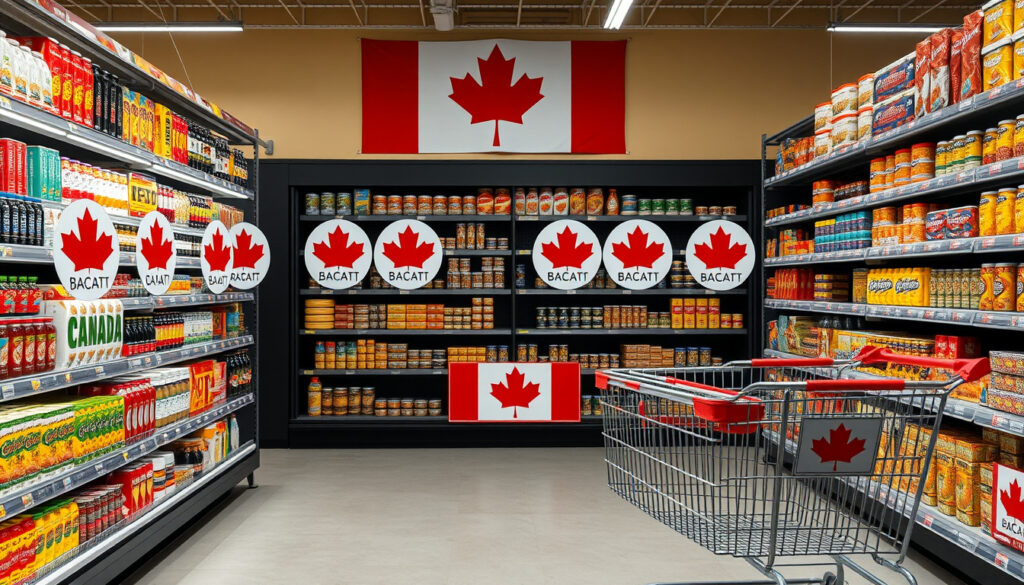
Canadian Shoppers Protest US Products – Tariff Boycott Impact
A wave of consumer action swept across Canada in early 2025 as shoppers began avoiding American products in response to President Trump’s tariffs on Canadian goods. What began as scattered protests in grocery stores quickly evolved into a sustained nationwide movement, with polling data showing between 71% and 98% of Canadians participating in some form of boycott by mid-year.
The movement, often referred to as the Buy Canadian campaign, has persisted into 2026 with measurable consequences for cross-border trade, tourism, and retail businesses on both sides of the border. Industry analysts estimate the boycott contributed to billions of dollars in losses for American businesses while simultaneously boosting domestic Canadian sales.
The origins of the boycott trace directly to the tariff impositions that began in January 2025, when the Trump administration levied duties ranging from 25% to 35% on Canadian exports. Within weeks, Canadian consumers had transformed trade policy frustration into a grassroots shopping movement that reshaped purchasing patterns across the country.
Why are Canadians boycotting American products in response to Trump’s tariffs?
The boycott emerged as an immediate response to sweeping tariff measures announced shortly after President Trump’s inauguration in January 2025. These duties, which would eventually reach 35% on certain Canadian goods by October 2025, targeted a wide range of exports including automobiles, steel, aluminum, and consumer products. The Canadian government responded with retaliatory measures of its own, but ordinary citizens moved faster than policy could follow.
Trump tariffs and annexation rhetoric
Grocery shoppers, sports venues, streaming services
Canada to Europe, UK, Mexico, and beyond
US products left unsold on store shelves
What the polling data shows
Polls conducted throughout 2025 revealed remarkable consistency in Canadian sentiment toward American goods. An Angus Reid survey conducted in late February 2025 found that 98% of respondents were actively seeking “Made in Canada” labels when shopping. Of those respondents, 48% indicated they were replacing as many American products as possible, while an additional 37% said they would switch to Canadian alternatives when price and quality were comparable.
More formal polling confirmed these trends. According to The Fulcrum, 71% of Canadians intended to purchase fewer American products during 2025, with 61% confirming they had begun actively boycotting American companies. Among those boycotting, 85% reported replacing at least some US items with Canadian substitutes.
The intensity of feeling appeared tied directly to political rhetoric emanating from the White House. Comments about Canada potentially becoming the “51st state” generated particular anger, with polling suggesting 91% of Canadians wanted to reduce their economic reliance on the United States. Some shoppers indicated willingness to pay higher prices specifically to avoid American goods, a pattern that generated increased complaints to the Canadian Food Inspection Agency about origin labeling accuracy.
Key insights from the boycott movement
- Consumer-led action preceded formal government endorsement of the boycott
- Label-reading behavior intensified dramatically, with complaints about misleading origin claims rising
- The boycott extended beyond groceries to include streaming services, restaurants, and retail
- Political expression through shopping became a recognized form of protest
- Small businesses on both sides of the border faced disproportionate strain
- The movement gained momentum as international coverage highlighted Canadian actions
Snapshot of established facts
| Fact | Detail | Source |
|---|---|---|
| Start date | February 2025 onward | Multiple news sources |
| Main trigger | Trump tariffs (25-35%) | The Fulcrum, Seafood Source |
| Key action | Buy Canadian at grocers | CTV News, NowToronto |
| Peak participation | 98% seeking Canadian labels | Angus Reid poll |
| Government support | Trudeau endorsed Feb 1 | Wikipedia sources |
| Economic toll (US) | $3 billion CAD from boycotts | Wikipedia sources |
How are Canadian grocers and shoppers participating in the boycott?
Grocery stores emerged as the primary battleground for the boycott, with Canadian consumers fundamentally altering their purchasing decisions at supermarkets, specialty food retailers, and big-box stores alike. The shift became visible within weeks of the tariff announcements, as store managers began reporting noticeable changes in shopping basket contents.
What stores are reporting
Provincial liquor control boards moved quickly to remove American products from their shelves, a significant action given their monopoly positions in most provinces. Beer, wine, and spirits bearing American labels disappeared from store displays, replaced in many cases by Canadian alternatives or products from other trading partners. Grocery store owners interviewed by business journalists confirmed that customers were actively seeking domestic alternatives and asking staff for guidance on identifying Canadian-made products.
A grocery store owner interviewed by CNBC described tangible shifts in purchasing patterns, noting that long-standing American brands were being passed over in favor of Canadian options. The movement appeared strongest among shoppers purchasing perishables, dairy, and meat products, where domestic alternatives were readily available.
Seafood departments saw particularly notable changes, with consumers prioritizing Canadian-caught fish and shellfish over American imports. The seafood sector became one of the first where boycott effects were documented, with retailers noting that customers would actively avoid products labeled with US origins even when Canadian alternatives cost more.
Labeling and consumer vigilance
The heightened attention to product origins created administrative challenges for retailers and regulators. The Canadian Food Inspection Agency received increased complaints about origin labeling, with consumers questioning whether products marketed as Canadian were genuinely domestic or merely underwent final processing in Canada. This scrutiny forced some retailers to reassess their supply chains and caused delays for products awaiting origin verification.
What products are most affected by the boycott?
Certain categories experienced more pronounced effects than others. Fresh produce, dairy, and meat sections saw the most dramatic shifts in consumer behavior, largely because Canadian alternatives were abundant and price-competitive. Frozen foods, packaged goods, and beverages also showed meaningful changes, though these categories sometimes lacked readily available domestic substitutes.
The alcohol sector provided one of the clearest examples of boycott impact. Provincial liquor boards, which control the majority of wine and spirit sales in Canada, systematically removed American products from their catalogs. California wines, American craft beers, and Bourbon whiskeys faced particularly strong consumer resistance, with some jurisdictions reporting complete sell-through of existing American inventory with no reorders.
Streaming services and digital entertainment also drew consumer attention. Subscribers canceled memberships to US-based platforms in favor of Canadian alternatives or international services, though the impact on these sectors proved more difficult to quantify. Restaurants featuring American-owned brands or ingredients faced similar scrutiny, with some establishments reporting explicit customer questions about product origins before ordering. The alcohol sector provided one of the clearest examples of boycott impact, as provincial liquor boards systematically removed American products from their catalogs, with California wines, American craft beers, and Bourbon whiskeys facing particularly strong consumer resistance, with some jurisdictions reporting complete sell-through of existing American inventory with no reorders, a situation that can be further understood by looking at how to convert 16 oz to grams.
How has the US responded to the Canadian boycott?
American businesses and industry groups initially dismissed the Canadian movement as temporary sentiment that would fade as tariff negotiations progressed. However, as consumer behavior persisted into late 2025, major US exporters began reporting sustained losses in Canadian market share. Agricultural exporters, in particular, found themselves unable to move products that had previously enjoyed strong Canadian demand.
Industry analysts estimated the cumulative economic toll to Canadian retailers and US exporters exceeded several billion dollars in disrupted commerce. US agricultural sectors reported significant inventory buildup as Canadian distributors reduced orders, while some American brands sought alternative markets to absorb displaced production.
The political response from Washington remained focused on tariff policy rather than consumer sentiment, with administration officials suggesting that negotiated trade solutions would restore normal purchasing patterns. Canadian observers noted, however, that the consumer movement had taken on characteristics of a broader cultural shift rather than a tactical response to specific trade disputes.
Looking ahead: The future of Buy Canadian sentiment
Into 2026, the boycott had demonstrated remarkable staying power despite fluctuations in tariff levels and political rhetoric. Surveys indicated that a substantial majority of Canadians intended to maintain modified purchasing habits, with preference for domestic products becoming a persistent factor in shopping decisions even as immediate political tensions eased.
The movement’s success in reshaping consumer behavior presented both opportunities and challenges for Canadian businesses. Domestic producers gained market position but faced pressure to maintain quality and pricing competitiveness. Retailers adapted by expanding Canadian-sourced product lines and improving origin labeling to meet heightened consumer demand for transparency.
The broader implications for North American trade remained uncertain. While official tariff structures continued to fluctuate, the unofficial consumer-driven dimension of the trade relationship had established new patterns that might persist independent of policy developments. For many Canadian shoppers, the boycott had evolved from a reaction to specific political events into a considered approach to consumption that prioritized domestic economic activity.
Frequently Asked Questions
When did the Canadian boycott of American products begin?
The boycott gained momentum in February 2025, shortly after the Trump administration announced sweeping tariff measures on Canadian imports. Consumer action preceded formal government endorsement, with individual shoppers initiating purchasing changes before official endorsement from Prime Minister Trudeau on February 1, 2025.
What percentage of Canadians participated in the boycott?
Polling data showed between 71% and 98% of Canadians participated in some form of boycott by mid-2025. An Angus Reid survey found 98% of respondents actively sought Canadian labels when shopping, with 61% confirming they had begun actively boycotting American companies.
What triggered the Canadian boycott?
The boycott emerged in response to Trump administration tariffs ranging from 25% to 35% on Canadian goods, announced in January 2025. Additional anger stemmed from comments about Canada potentially becoming the “51st state,” with 91% of Canadians indicating they wanted to reduce economic reliance on the United States.
What products were most affected by the boycott?
Fresh produce, dairy, meat, and seafood saw the most dramatic shifts due to readily available Canadian alternatives. Provincial liquor boards removed American alcohol products, while streaming services and restaurants also experienced consumer scrutiny over American origins.
What economic impact did the boycott have?
Industry analysts estimated billions of dollars in losses for American businesses, with US exporters in agricultural sectors particularly affected. Canadian domestic sales benefited from the shift in consumer behavior, with retailers reporting increased demand for Canadian-sourced products.
More related posts
 How to Edit PDF for Free: Online, Word, Mac, iPhone
 Jung So-Min: Relationship Status, Surgery Rumors & Facts
 Travis Dhanraj: Resignation from CBC, Testimony, and Biography
 COVID-19 Razor Blade Sore Throat: Symptoms, Treatment & Duration
 Let It Be Lyrics: Meaning, Analysis, and John Lennon’s View
 Ricky Hatton Death Cause: CTE and Alcohol Toxicity
 Lauryn Hill: Biography, Children, Music Career & Controversies
 Graham Norton: Husband, Show Future, Private Life in Ireland
