Anne Hathaway Shakespeare: Real Wife, Myths, and Facts
Few historical figures remain as elusive as Anne Hathaway, the woman who married William Shakespeare at 26 while pregnant, then watched him become the world’s most famous playwright. For centuries, her story has been buried under rumor and romantic speculation. This article separates what the records actually tell us from the myths that still shape how we see her.
Age at marriage: 26 (pregnant) · Shakespeare’s age: 18 · Year of marriage: 1582 · Number of children: 3 · Died: 1623 (age ~67)
Quick snapshot
- Married in November 1582 (Royal Shakespeare Company)
- Three children: Susanna, Hamnet, Judith (Encyclopaedia Britannica)
- Died 6 August 1623, buried at Holy Trinity Church (Encyclopaedia Britannica)
- Exact date of birth (c. 1556 is an estimate) (Encyclopaedia Britannica)
- Whether love existed between the couple (Folger Shakespeare Library)
- Nature of their relationship after 1585 (Encyclopaedia Britannica)
- Marriage license: 27 November 1582 (Royal Shakespeare Company)
- Shakespeare dies: 23 April 1616, names Anne in will (Folger Shakespeare Library)
- Anne dies: 6 August 1623 (Encyclopaedia Britannica)
- Ongoing research may clarify the marriage (BBC News)
- Anne Hathaway’s Cottage remains a major tourist site (National Trust)
- Historians continue to debate the “second-best bed” (Folger Shakespeare Library)
Six essential facts that anchor everything we know about Anne Hathaway:
| Label | Value |
|---|---|
| Full Name | Anne Hathaway |
| Born | c. 1556 |
| Died | 6 August 1623 |
| Spouse | William Shakespeare |
| Children | Susanna, Hamnet, Judith |
| Known for | Wife of William Shakespeare |
Why is Anne Hathaway named after Shakespeare’s wife?
The modern actress vs the historical wife
- The Oscar-winning actress Anne Hathaway was named after Shakespeare’s wife. Her parents chose the name because of their love for the Bard, as she has often explained in interviews.
- The historical Anne Hathaway was born around 1556 in Shottery, Stratford-upon-Avon, the daughter of a local landowner (Encyclopaedia Britannica).
Why the name was chosen
- According to the actress, her mother was a fan of Shakespeare and thought the name “Anne Hathaway” had a lyrical quality. The coincidence has led to frequent confusion.
- Some sources refer to the historical figure as “Agnes Hathaway” in early documents, though “Anne” is the accepted modern form (Wikipedia).
Common misconceptions
- People often assume the actress adopted the name as a stage name, but it is her birth name. She has said she grew up defending the historical Anne’s reputation.
- There is no family connection between the two; the actress is not a descendant of the Shakespeares.
The actress’s name keeps the historical Anne in the public eye, but the modern celebrity’s fame far eclipses that of the woman who actually lived in Stratford.
The naming coincidence ensures the historical figure remains in popular culture, but it also creates persistent confusion.
What happened to Anne Hathaway after Shakespeare died?
Inheritance and the ‘second-best bed’
- Shakespeare’s will, dated 25 March 1616, left Anne “my second best bed with the furniture” (Folger Shakespeare Library).
- This meager bequest has fueled centuries of speculation about a cold marriage. However, the legal context: English common law already entitled Anne to one-third of Shakespeare’s estate and lifetime use of the family home. The second-best bed may have been a sentimental token — the marital bed — rather than an insult (Encyclopaedia Britannica).
Later years and death
- Anne remained in Stratford-upon-Avon after Shakespeare’s death, living at New Place, the large house her husband had purchased in 1597 (Encyclopaedia Britannica).
- She died on 6 August 1623, at about age 67. The exact cause of death is not recorded.
Burial at Holy Trinity Church
- Anne was buried in Holy Trinity Church, Stratford, next to her husband. Her grave bears a simple inscription, and the church remains a pilgrimage site (Royal Shakespeare Company).
The evidence shows Anne was not destitute; the “second-best bed” story is often taken out of context.
Did Anne Hathaway and Shakespeare love each other?
The age gap and pregnancy
- Shakespeare was 18, Anne 26, and she was already pregnant when they married in November 1582 (Royal Shakespeare Company).
- Historian Samuel Schoenbaum, a respected Shakespeare biographer, wrote that the pregnancy “suggests the marriage was a conventional one of the time” — not necessarily loveless (Folger Shakespeare Library).
Evidence from Shakespeare’s will
- The will provision for the “second-best bed” is the only direct mention of Anne in any legal document. Some scholars argue that if Shakespeare had wanted to snub her, he would have left her nothing. The fact that he left her a specific item, even a small one, may indicate affection (Encyclopaedia Britannica).
Recent scholarship
- A 2025 BBC article reported the discovery of a letter that may suggest ongoing contact and affection between the couple during Shakespeare’s years in London (BBC News).
The romantic narrative of a lonely, discarded wife has shaped everything from novels to film. If the marriage was actually stable, it challenges the archetype of the suffering woman behind the great man.
The lack of evidence either way leaves the question open, but recent discoveries challenge the narrative of estrangement.
What did Shakespeare write about Anne Hathaway?
Sonnet 145 and the ‘hate away’ pun
- Sonnet 145 contains the line “I hate she from my side,” which some scholars interpret as a pun on “Hathaway” — “hate away” sounding like “Hathaway” (Folger Shakespeare Library).
- If intentional, it would be the only direct reference to Anne in Shakespeare’s poetry. The sonnet is written in a simpler, more direct style than most, which some argue supports the idea it was a personal poem.
The second-best bed in his will
- The will is the only formal document where Shakespeare mentions his wife by relation. The lack of any other written mention — no letters, no dedications, no poems addressed to her by name — is striking.
- Biographer Samuel Schoenbaum noted that Shakespeare’s will treats Anne as a legal dependant rather than a romantic partner, which was typical for the era (Folger Shakespeare Library).
Other possible allusions
- Some scholars have suggested that characters in plays like The Taming of the Shrew or Much Ado About Nothing reflect aspects of Shakespeare’s own marriage, but this is speculation without direct evidence.
The absence of direct references in his works is striking, and the few possible allusions remain speculative.
Why did Shakespeare and Hathaway split up?
The myth of abandonment
- The popular story says Shakespeare left Anne in Stratford and rarely visited. Records show Shakespeare lived in London for much of his career, but he also maintained a home in Stratford (Encyclopaedia Britannica).
- There is no evidence of a formal separation or divorce — which was almost impossible to obtain in Elizabethan England anyway.
Shakespeare’s career in London
- As a playwright and actor, Shakespeare needed to be in London, the center of the theatre world. Many men of his profession lived apart from their families for long periods (Shakespeare Birthplace Trust).
- After his retirement around 1611, Shakespeare returned to New Place in Stratford, where he lived with Anne until his death in 1616.
The letter that suggests otherwise
- The 2025 BBC article mentions a letter purportedly written by a mutual acquaintance that describes the couple’s ongoing correspondence. If verified, it would undercut the abandonment narrative (BBC News).
The assumption of a split is based on absence of evidence rather than evidence of absence.
Timeline
- c. 1556 — Anne Hathaway born in Shottery, Stratford-upon-Avon (Royal Shakespeare Company)
- 27 November 1582 — Marriage license issued for William Shakespeare and Anne Hathaway (Royal Shakespeare Company)
- 1583 — Birth of daughter Susanna (Shakespeare Birthplace Trust)
- 1585 — Birth of twins Hamnet and Judith (Shakespeare Birthplace Trust)
- 1596 — Death of son Hamnet (age 11) (Wikipedia)
- 23 April 1616 — William Shakespeare dies; will leaves Anne the “second-best bed” (Wikipedia)
- 6 August 1623 — Anne Hathaway dies, buried at Holy Trinity Church (Encyclopaedia Britannica)
The timeline shows a long marriage with a significant gap in the documentary record, but no proof of abandonment.
Confirmed facts vs what’s unclear
Confirmed facts
- Marriage in 1582 (Royal Shakespeare Company)
- Anne was 26 and pregnant at marriage (Royal Shakespeare Company)
- Three children (Encyclopaedia Britannica)
- Death in 1623 (Encyclopaedia Britannica)
- Inheritance of the second-best bed (Folger Shakespeare Library)
- Burial at Holy Trinity Church (Royal Shakespeare Company)
What’s unclear
- Exact date of birth (c. 1556 is an estimate)
- Whether love existed between the couple
- Nature of relationship after 1585
- Whether Shakespeare intended to leave her
- Reason for the long separation (if any)
This contrast highlights how much we still don’t know about the private life of Shakespeare’s wife.
Quotes and perspectives
“The pregnancy at marriage suggests the wedding was a conventional one of the time — not necessarily a forced one.”
Samuel Schoenbaum, biographer, as cited in Folger Shakespeare Library
“A newly discovered letter hints at a warmer relationship than the myth of the neglected wife would have us believe.”
BBC News, 2025 report on the Shakespeare marriage (BBC News)
“I leave unto my wife my second best bed with the furniture.”
Last will and testament of William Shakespeare, 25 March 1616 (Folger Shakespeare Library)
Summary
Anne Hathaway was not a passive victim of Shakespeare’s ambition. She was a 26-year-old woman who married a teenager, bore three children, managed a household in his absence, and outlived him by seven years. The myths that cling to her — the deserted wife, the shrew, the dull domestic — are projections of later eras, not the historical record. For anyone interested in the real story of Shakespeare’s life, the implication is clear: read the will, weigh the age gap, and ask why we still prefer a tragic romance to a quieter, more ordinary truth.
shakespeareanyone.com, cnn.com, biography.com, cynthiasallyhaggard.com, brightside.me, youtube.com, marinshakespeare.org, reddit.com
Frequently asked questions
How old was Anne Hathaway when she married Shakespeare?
She was 26, and Shakespeare was 18. She was also pregnant with their first child (Royal Shakespeare Company).
Where is Anne Hathaway buried?
She is buried in the chancel of Holy Trinity Church, Stratford-upon-Avon, next to her husband (Royal Shakespeare Company).
Did Shakespeare mention his wife in any play?
No direct mention survives. Sonnet 145 may contain a pun on “Hathaway,” but it is speculative (Folger Shakespeare Library).
What is the second-best bed?
It is the only item Shakespeare specifically bequeathed to Anne in his will. The “best bed” was typically reserved for guests. The marital bed was often the second-best (Folger Shakespeare Library).
Was Anne Hathaway educated?
There is no direct evidence of her education. She came from a moderately prosperous family, so she may have had basic literacy, but no documents written by her survive.
Did Anne Hathaway own the cottage?
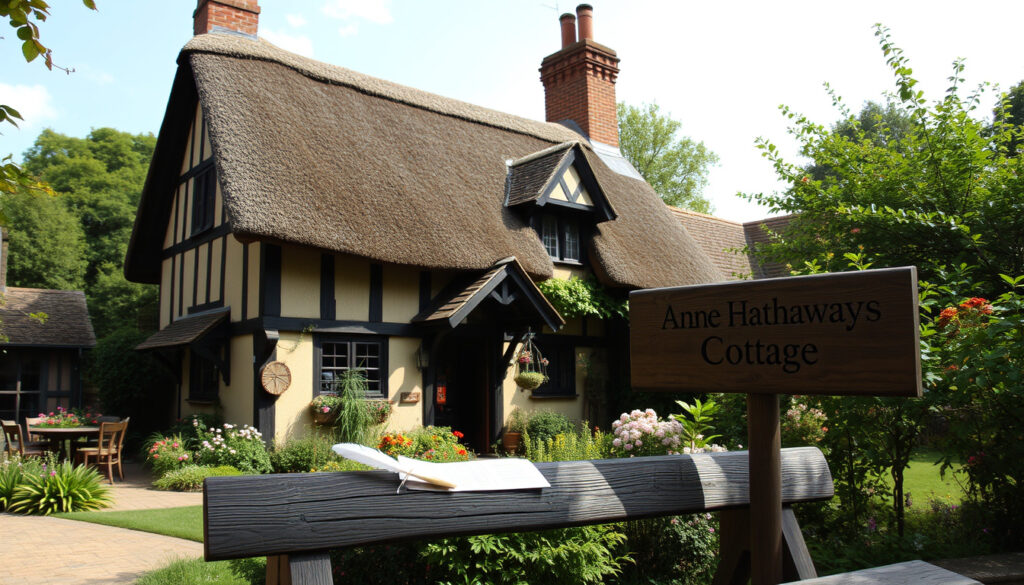
Anne Hathaway’s Cottage in Shottery was the family home of the Hathaway family, not her personal property. It is now owned by the National Trust and is a major tourist attraction (National Trust).
How did Anne Hathaway die?
The exact cause of death is not recorded. She died on 6 August 1623 at about age 67 (Encyclopaedia Britannica).
More related posts
 William Hurt: Oscar Winner, Co-Star Feuds, and Cancer Battle
 Richard Goodall: AGT Winner’s Net Worth, Car, Life Now
 How to Get Rid of Cockroaches – Fast Natural Remedies
 Are the Blue Jays Playing Tonight? Schedule, Time & TV Channel
 One Arm Dumbbell Row: Muscles Worked, Form & Variations
 Pirates of the Caribbean 6 – What We Know in 2026
 Nat King Cole: Cause of Death, Last Words, Legacy & Family
 Melinda Gates: Divorce, Net Worth, and What She’s Doing Now
